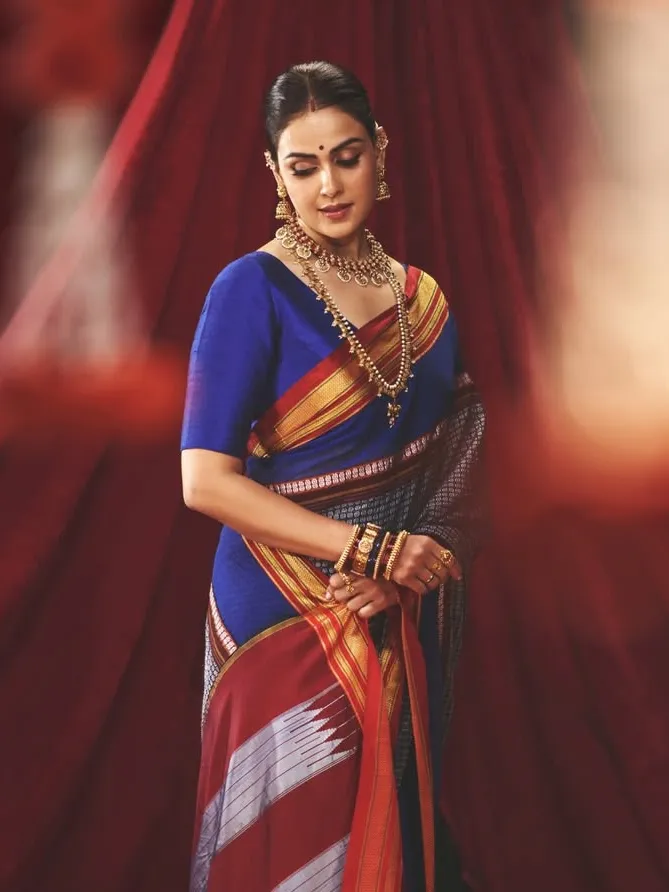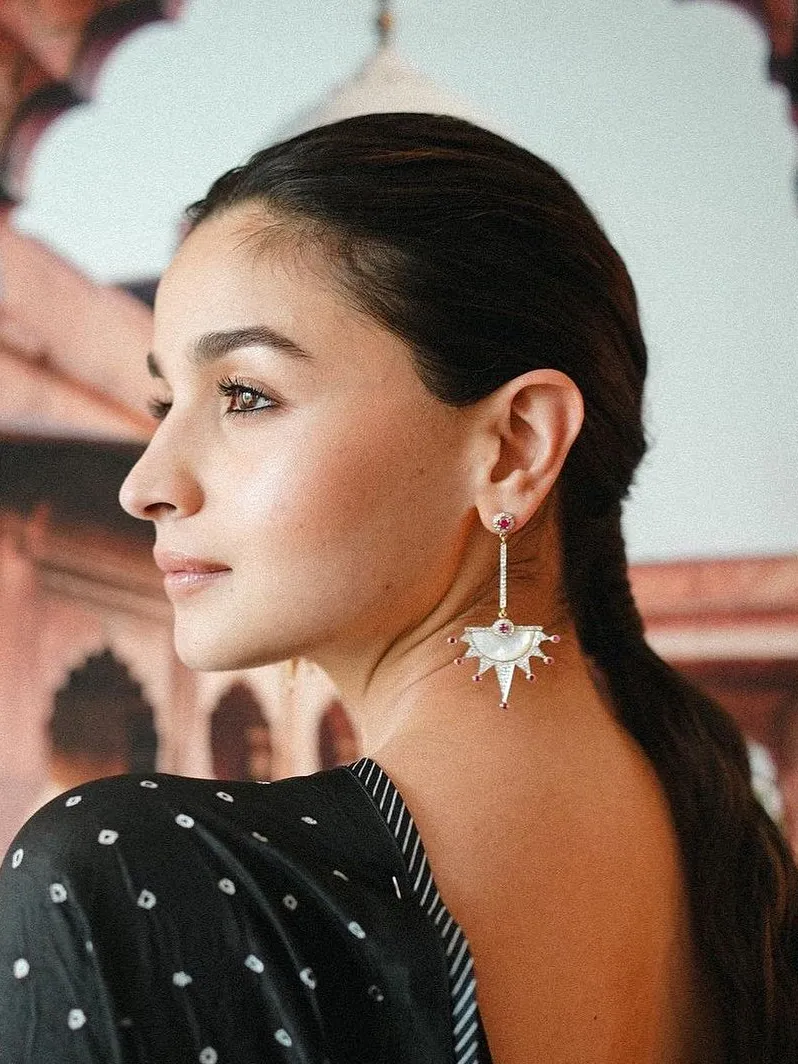
It all started with a wild goose chase in Banaras (Varanasi),” recalls Swati Agarwal. One half of the label Swati & Sunaina Gold, the designer traces the brand’s origin story back a decade ago when, inspired by her Marwari family’s trove of heirloom saris, she set out to find a rangkaat (a complex weaving technique that interlocks silk with zari threads) drape for her brother’s wedding.
The search was obsessive—calls to President’s Award– winning artisans, hours spent poring over Weaver Service Centre booklets, even a cold hunt through Varanasi’s bylanes. She never found the rangkaat she had dreamed of, but discovered a new calling instead.
In a landscape crowded with Banarasi brocade brands, Agarwal and her sister-in-law Sunaina Jalan have conjured up an anomaly. Their focus is the single-edition sari, which means no two patrons will ever own the same piece. Exclusivity is taken so seriously that they do not even maintain a physical archive of their actual creations (they do chronicle through sketches and samples). Each collection is a capsule of just six design directions, with 12 to 18 pieces in singular colourways. With pieces starting at ₹3 lakh, these are not impulse buys.
Met Gala 2026 is almost here. Are you ready? NOTIFY ME
By signing up you agree to our User Agreement (including the class action waiver and arbitration provisions), our Privacy Policy & Cookie Statement and to receive marketing and account-related emails from Vogue. You can unsubscribe at any time. This site is protected by reCAPTCHA and the Google Privacy Policy and Terms of Service apply.
Since the beginning, the founders have worked exclusively with Banarasi textiles, drawing on dampach, kadua, jamdani, rangkaat and gyaser (their interpretation of the Indo-Tibetan textile). But each comes with interventions. Where others would settle for neat colour panels in rangkaat, they tied the blocks with woven bows. Their intervention in gyaser required looms that normally yielded only 23 inches to be adapted to accommodate an entire sari—a feat never attempted before.
Their Vanya collection of 24 saris brought wild silks from the Northeast—eri, tussar, muga and mulberry—into the Banaras gharana. The kora or white nature of these silks was paired with motifs inspired by Indian white flowers (rajnigandha, juhi, bela, champa, aparajita and brahmakamal) as well as miniature Kangra paintings of Krishna in the night garden.
What makes Swati & Sunaina Gold stand out in a competitive market is “their research vis-à-vis history, design and the technique applied in their collections,” explains textile curator Lavina Baldota. It’s little wonder that these saris, sans shiny embellishment or accoutrement, “demand a certain price”, she adds.
This dedication to detail is evident in their collections. The pair took four trips to France and wrote a thesis on the India-France textile connection before releasing the newest Varanasi to Versailles line, which showcases a fine mix of brocade and French lace.
As India experiences a revivalist moment, and formal contemporary textile museums remain rare, the role of individual designers and collectors becomes even more crucial. Agarwal shares that a young bride from Hyderabad commissioned a sari for her wedding. “She’d met her fiancé only a couple of months prior, but the connection felt cosmic, and she wanted her bridal look to reflect that.”
La Prairie Skin Caviar Luxe Eye Cream
The team created a piece that drew from the couple’s astrological signs, lucky numbers and intertwined names in a Telugu script. The bride archived the entire process, proving that collectors who buy refined textiles value the journey as deeply as the finished weave itself.
Most Popular
- HoroscopeHoroscope Today: April 19, 2026By Snehaa Khanna Sahgal
- HoroscopeAquarius Horoscope Today: April 19, 2026By Snehaa Khanna Sahgal
- HoroscopeAries Horoscope Today: April 19, 2026By Snehaa Khanna Sahgal
To the sisters-in-law, as with other skill-led designers— Chinar Farooqui of Injiri and her quiet devotion to jamdani; Sanjay Garg of Raw Mango, who has expanded the handloom lexicon; Pankaj S with his luminous Murshidabad mul; and Aadyam Handwoven with its explorations in ikat—speaking about process and their long-term relationships with makers isn’t marketing. It’s a responsibility.
Shiseido Future Solution LX Eye And Lip Contour Regenerating Cream
Which is why conversations must shift beyond focusing on how many hours a weaver spent at the loom or which mythological character inspired a motif. The sharper question is whether stakeholders—not just the weaver but the yarn dyer, the spinner, the jacquard punch maker, even the loom maker—are compensated well enough to continue this work. Exhibitions that showcase skill, patronage that inspires continuity and above-market pay structures are what separate romanticism from real commitment. Agarwal and Jalan understand that difference.
“I don’t think weaving is a dying art form, but it is certainly an ageing one,” Agarwal says, contemplatively. The renewed fascination with handlooms has helped both small ateliers and big brands, but she points to a new threat. “Many young weavers may not have the patience or focus like their forefathers did.” She notes many young practitioners’ attention spans have been hijacked by their phone while a power loom grunts on the side.
For years, the fear was that the new hands would just not have the same agility. Now, it’s focus that is slipping away. And in that quiet fading of concentration lies the real fragility of the craft Agarwal and Jalan are trying so hard to protect.
This story appears in Vogue India’s March-April 2026 issue. Subscribe here.